
They
On dehumanizing rhetoric in Trump's America and Erdoğan's Turkey

Greetings. I’m a Canadian journalist and writer based in Brussels who’s mostly covered Turkey. I’ll write more about myself and my connection to Turkey later, but for now, here’s my first post about the noxious rhetoric and virulent political atmosphere following the Charlie Kirk assassination, and how it reminds me of my time living and reporting through a very bleak period in Turkey.
Like many other Turkey watchers, when I read the news about Trump’s America, I often get flashbacks to Erdoğan’s Turkey, and never more so than following the murder of MAGA luminary Charlie Kirk. The dehumanizing language, victim complex, Us vs. Them mentality and overall war-like atmosphere, complete with martyrs, invaders and traitors, brought back uncomfortable memories. But one particular linguistic trick really caught my eye.
Immediately following the murder, the response from the MAGA movement was a call to arms. Not a great deal is known about the suspect, Tyler Robinson, beyond the fact that he was a “Reddit kid” who found Kirk’s rhetoric abhorrent. But Robinson certainly didn’t represent or have known ties with any coherent political organization, and no such group celebrated Kirk’s death. So who was this call to arms against? Many figures denouncing the attack seemed to blame not ‘him,’ but ‘they.’
"They kill and terrorize their opponents, hoping to silence them," said Director of National Intelligence Tulsi Gabbard, at Kirk’s memorial (emphasis mine in all cases). “They tried to silence my friend Charlie Kirk,” echoed Vice President JD Vance. “If they won’t leave us in peace, then our choice is fight or die,” Elon Musk posted on X. “They cut him down with an assassin’s bullet,” MAGA ideologue Steve Bannon said. “We can’t allow for these people to live among us in society,” far-right political agitator and Trump confidante Laura Loomer wrote.
We didn’t have to guess for long who exactly ‘they’ are. “Democrats own what happened today,” Republican congresswoman Nancy Mace told reporters upon news of the shooting, baselessly referring to the then-unknown suspect as a “raging leftist lunatic.” “Y’all caused this!” Republican Anna Paulina Luna screamed at Democrats during a moment of silence for Kirk in Congress.
We’re meant to understand that Kirk’s assassin wasn’t a lone gunman, but a shadowy, amorphous ‘them’, which seems to be an expedient cross-section of MAGA’s peaceful, legal political opponents (who overwhelmingly denounced Kirk’s murder). In this epic narrative, the victim isn’t just Kirk, but all of MAGA (which would dubiously include the suspect’s own family). “The gun was pointed at him, but the bullet was aimed at all of us,” President Trump asserted at the memorial.
Others cast their nets even more broadly, beyond political parties. “The Left is a national security threat,” Loomer screeched on X. “The Left is the party of murder,” Musk barked.
Fox News demagogue Jesse Watters starkly drew the battle lines between ‘us’ and ‘them’: “Charlie was one of us...They came after Kavanaugh with a rifle to his neighbourhood. They went after Musk’s cars. They just shot two Jews outside the embassy...It’s happening: you’ve got trans shooters, you’ve got riots in LA. They are at war with us.” The ‘they’ starts off vague, if implied, but his next comments chillingly hinted toward an expanding and increasingly dehumanized target: “Everybody’s accountable, and we’re watching what they’re saying on television and who’s saying what: the politicians, the media and all these rats out there.”
At Kirk’s memorial, in front of nearly 100,000 people, white nationalist MAGA policy architect Stephen Miller, after referencing ‘they,’ directly addressed this elusive enemy, shifting to a disquieting ‘you’:
“You are wickedness, you are jealousy, you are envy, you are hatred, you are nothing…You thought you could kill Charlie Kirk? You have made him immortal…We will carry Charlie and Erika in our heart every single day and fight that much harder, because of what you did to us. You have no idea the dragon you have awakened…We are on the side of God!”
It soon became clear that large swathes of MAGA believe their revolutionary movement is in a state of war. “Charlie Kirk’s a casualty of war. We’re at war in this country,” Bannon said on his podcast. Disinformation czar Alex Jones seemed enamored with the idea, babbling that, “This is a war, this is a war, this is a war. This is the war...This is it, get ready.”
Bannon’s fervent cohost Jack Posobiec proclaimed at the memorial that “Charlie Kirk died for all of you,” conjuring images of a Holy War. “Are you ready to fight back, and are you ready to put on the full armour of God and face the evil in high places and the spiritual warfare before us?” he screamed at the end of his speech, his voice taking on a guttural tone.
Vice President Vance kept in line with the Holy War imagery as he declared Kirk “a martyr for the Christian faith.” Right-wing pundit Benny Johnson invoked the “Godly mission of wielding the sword against evil,” for example, by having “a million kids…millions and millions and millions of Charlie Kirks,” so that “we can save our land.”
Asked on Fox News how Americans can fix the country and “come back together,” Trump answered that he “couldn’t care less.” Speaking later at the memorial, he boasted that, unlike that softie Kirk, “I hate my opponents.” Later, he gave a speech in front of the military’s top brass, threatening to use Democrat-governed cities as training grounds for the United States military, warning against an “invasion from within,” and lamenting that “these people don’t wear uniforms,” making them harder to “take out.”
As if the implication that violence is sanctioned and even required in a state of war wasn’t enough, some voices within MAGA started to explicitly call for it. An editor at the Daily Caller wrote an extraordinary column calling for “disproportionate” violence against liberals. “Is this a call for violence? Yes. Explicitly it is,” he fulminated. “Break bones…I want blood in the streets.”
Watching all this unfold with fascinated horror, it struck me how eerily familiar it was, as I’m hit with flashbacks from a feverish period in Turkey when I became accustomed to a war-like political atmosphere and widespread vilification of entire swathes of the population, and where I first encountered the nefarious ‘they.’
I moved to Istanbul in January, 2014, the year after the massive Gezi protests when President Erdoğan showed his true colours as a thin-skinned, paranoid, paternalistic autocrat, and one month after a simmering feud finally erupted between Erdoğan and his former allies, the Gülen movement (which by 2016 crescendoed into a brutal failed military coup, followed by an enormous purge going far beyond the Gülenists or coup involvement).
But it was 2015-16 that was perhaps the most tumultuous time in Turkey’s already turbulent recent history, marked by a violent insurgency, a dozen major terror attacks in big cities, severe government oppression against all manner of critic, countless acts of political violence, particularly against journalists and (especially opposition) politicians, political murders, the continued government takeover of the media and higher education, a migrant crisis and economic tumult, as well as the attempted coup and purges.
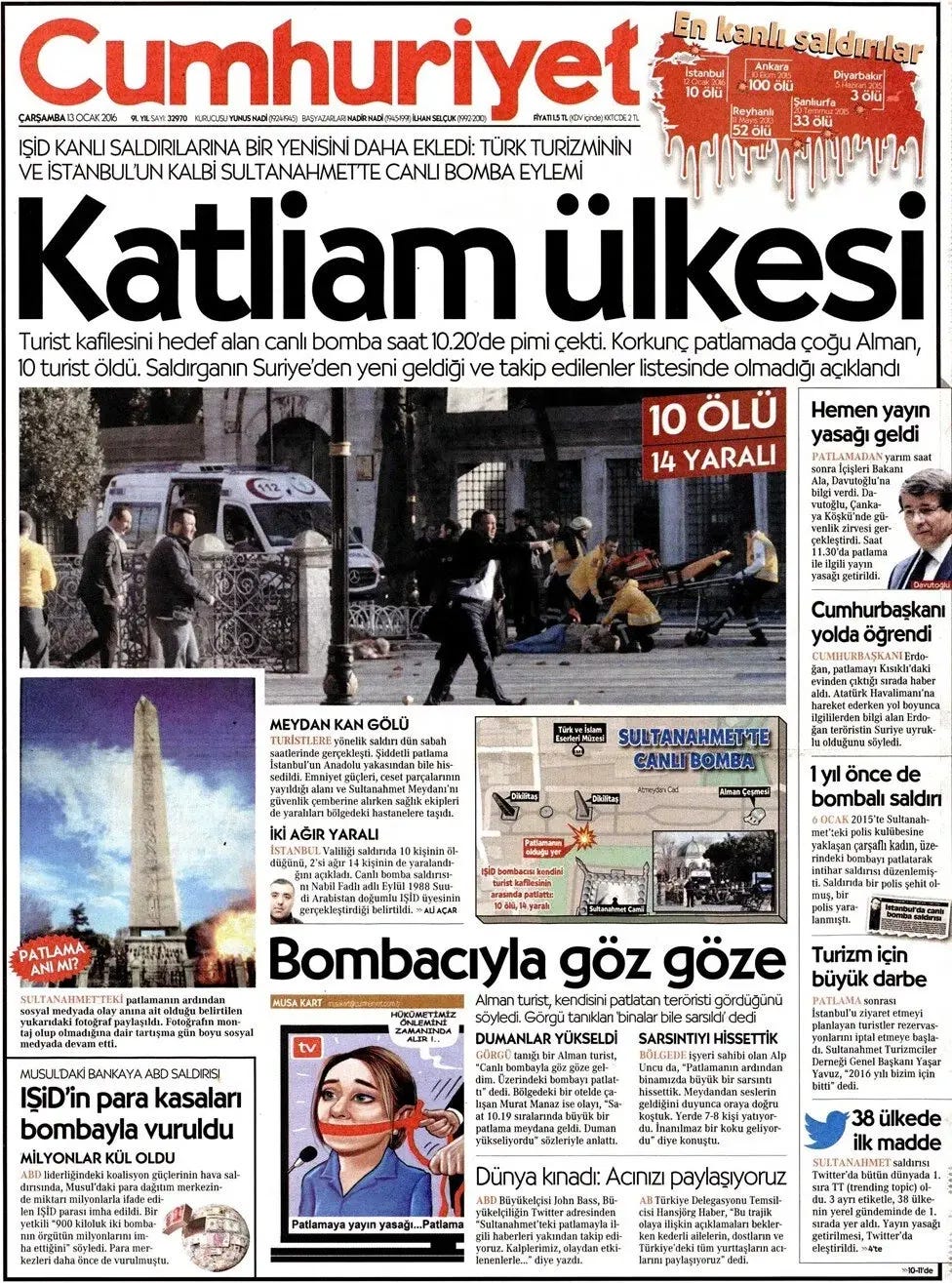
President Erdoğan only seemed to benefit from the endless chaos. “Erdoğan has made his political survival dependent on inculcating a sense of siege among his supporters and maintaining very high levels of social tension,” analyst Gareth Jenkins told me at the time.
Erdoğan crafted a grand narrative of a country besieged by enemies, with only the president himself keeping them at bay. “We are fighting a struggle for existence,” he declared in a speech in September 2015, after sending his regards to “our martyrs,” a term reserved for soldiers and slain government supporters, but never for the other side. “As long as this life is in this body, we will continue this struggle until the end. They are targeting our state, our government and me. They are targeting us both at home and abroad.”
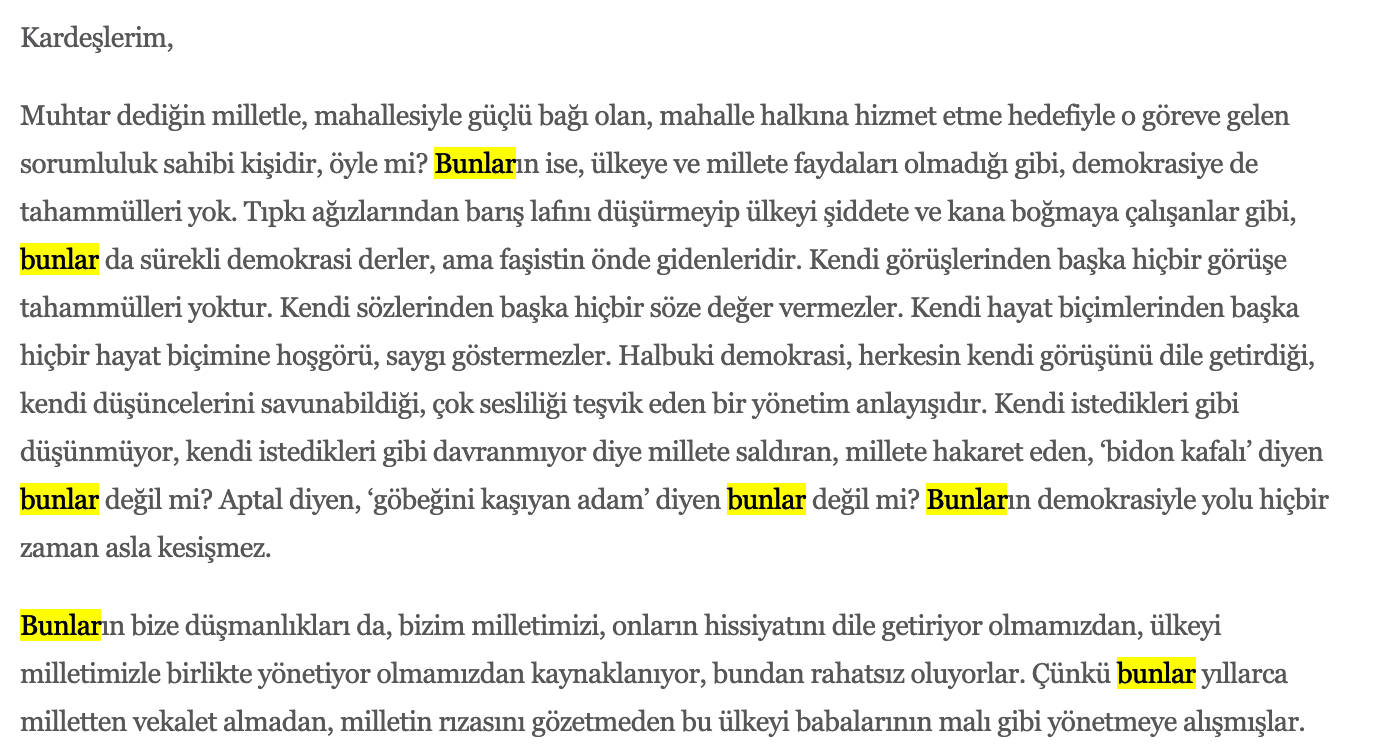
And here we encounter, once again, the mysterious ‘they.’ Erdoğan often refers darkly to ‘onlar’ — they — or even ‘bunlar,’ which literally means ‘these,’ but can refer contemptuously to people, in something akin to the “these people” invoked by the MAGA acolytes seeking to exploit Charlie Kirk’s murder.
“These people are…useless to the country…they are the ultimate fascists,” he seethed in one unexceptional speech during the febrile period leading up to the November 1 repeat elections in 2015. He contrasts “these people” with his audience of muhtars (village/neighbourhood head), whom he addresses as “my dear brothers.” All the classics are present in his speech: Us vs Them, political opponents as illegitimate alien traitors, the victim complex and Erdoğan as the physical manifestation of the halk (folk, people), his goals the natural expression of the milli irade (national will).
“For years, they have been imposing their ideologies, which are incompatible with the spirit and essence of this land, on the nation…Of course, we also know that this mob of people who are so alienated from, even hostile to, their own country, their own society, their own history, culture and civilization, are not fighting against us, but against the nation. What they cannot tolerate is that it is not me who occupies this office, but the very nation itself.”
The same evening of Erdoğan’s speech, shots are fired at the main opposition CHP’s headquarters, hardly even a notable event during this dark period of Turkish history.
But just who are these malevolent forces, bunlar? As the scholar Alper Yağcı has written, “In a nutshell, it is the institutional political establishment. It appears in various avatars like ‘the elites’, ‘mon chérs’, ‘Ankara’, ‘CHP mentality’, ‘one-party mentality,’ ‘the old order’, ‘bureaucratic oligarchy’ or simply ‘the bureaucracy’.” I’d go even further, and suggest that bunlar can be just about anyone who opposes Erdoğan, with a special ire for anyone who doesn’t fit into the idealized pious Sunni patriot category promoted by the government.
Yağcı illustrates Erdoğan’s use of bunlar in more detail:
“While addressing ‘our people,’ Erdoğan consistently refers to “them” as bunlar. A move of [his] hand liberally pointed toward the ground accompanies his words, figuratively showing the low level that he is talking about. In this language, there is an inversion of the disdain that the simple, religious man received from the Westernized elite…it is now the people who disdains the elite’s incompetence…the man in the street is accorded the upper position, he is recognized as the possessor of a higher knowledge that emanates from the street.”
In another speech in November, 2017, Erdoğan spelled out with stark clarity the malleable nature of ‘they’:
“In our struggle to protect and advance the legacy we inherited from our ancestors, we never knew who would stand in our way. At times, they appeared before us in the guise of coup plotters and junta members; isn’t that right? At times, they cloaked themselves in the guise of [military] tutelage, at times in the guise of international organizations, at times as armed terrorists, at times as economic saboteurs. In reality, they were all different faces of the same prism.”
The power and danger of ‘they,’ or ‘these people’ is that it can be anyone, usually one’s most convenient opponent or target. It transforms an isolated crime into a conspiracy, and an individual into a shadowy, faceless mass. It reinforces factional, Us vs. Them, Manichean frameworks of viewing the world. By not naming the ‘they,’ it’s easier to dehumanize the target, to rob it of personhood. This rhetoric transforms legitimate opposition into heinous traitors, and politics becomes a winner-takes-all fight to the death.
Erdoğan didn’t create polarization in Turkey, but his rhetoric foments societal divisions perhaps more viciously than any leader before him. “[T]he divisive language Erdogan uses sets powerful norms of appropriate behavior for supporters, while also delineating who belongs to ‘us’ and who is relegated to ‘them,’” wrote scholar Lisel Hintz, following the largest of many terror bombings in 2015. “Far from being empty words, this repeated othering behavior by a leading figure cultivates an atmosphere in which animosity is the norm and violence is not only tolerated, but actually rewarded.”
After the November 2015 elections, a columnist wrote that “pro-government media are in the mood as if they have won a war, not an election,” with headlines focusing on “revenge, kneeling, subjugation and calling to account.”
During this period, Erdoğan referred to opposition politicians as terrorists, and brawls often broke out in parliament. “We should be throwing them out of the Grand National Assembly, or even denaturalize them. These people cannot be MPs or citizens of this country,” he said in April 2016, referring to his main political targets, the leftist, pro-Kurdish HDP. The party was relentlessly, violently, sometimes fatally attacked by ISIS, nationalist mobs and the police countless times, especially near elections. In November, the party’s leadership was arrested.
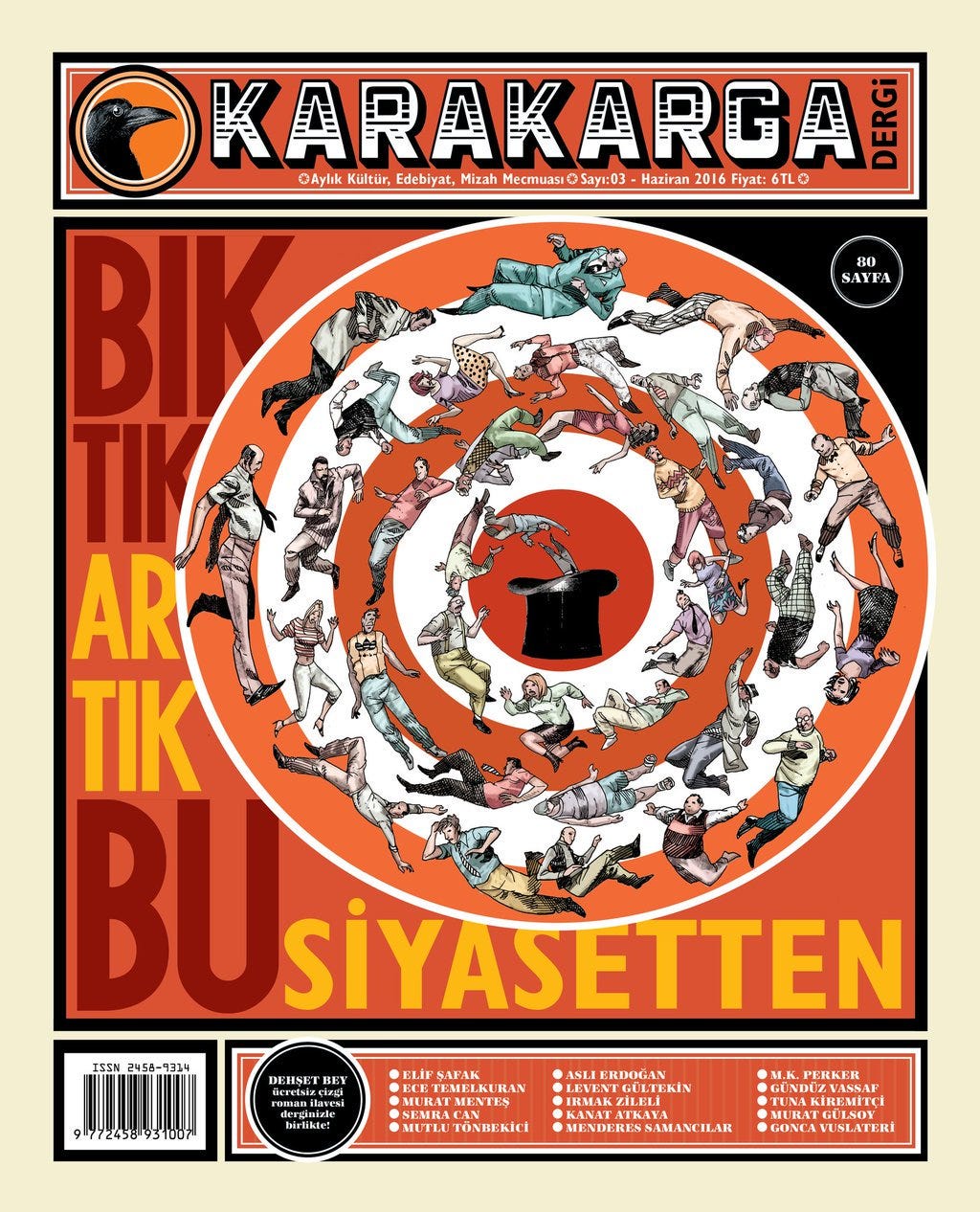
Erdoğan also attacked academics who signed a declaration calling for peace in the southeast, such as in this scathing speech in August 2015:
“Those who say they are backing terrorists…are stabbing daggers into the back of this homeland…The so-called intellectuals and columnists who support this betrayal are responsible for every death and every tear shed; they are in a state of treason…This rootless, immoral and unscrupulous group, who do not belong to the homeland or the nation, should not think that they will get away with what they do.”
Thousands of these academics would eventually be investigated, detained and purged. In January 2016, a mob boss and Erdoğan ally threatened to “take a shower” in their blood.
Erdoğan also targeted critical journalists, hundreds of whom were fired, investigated, sued, and even physically attacked. “The person who wrote this story will pay a heavy price for it; I won’t let him go unpunished,” he said in May 2015, targeting Can Dündar, the editor-in-chief of Cumhuriyet newspaper. One year later, Dündar was shot at by a man shouting “traitor,” and eventually had to flee abroad.
In another incident, thugs from Erdoğan’s AKP hospitalized prominent columnist Ahmet Hakan. Prior to the attack, fervently pro-government columnist Cem Küçük had threatened to crush Hakan “like a fly.”
One could go on forever collating examples of Erdoğan and his allies barraging their (overwhelmingly peaceful) opponents with vicious rhetoric, many of whom then fall prey to violence. Research shows decisively that dehumanizing speech from elites “facilitates acts of aggression and violence.”
When leaders and their mouthpieces conjure a nebulous “they,” they invite followers to see their fellow humans not as legitimate opponents, but as enemies to be defeated. Erdoğan perfected this style of siege politics years ago, and Trump’s movement is adopting a similar strategy: a permanent state of emergency in which politics becomes war, dissent becomes treason, and violence becomes virtue.
Great piece, thank you! This polarisation is such a disturbing trend, and one that makes a mockery of electoral politics as it leaves voters with impossible choices.